Free shipping across India on orders over ₹1,499 · See this season’s offers

Home / Know Your Ingredients / Khejur Gur
Dawn Nectar, Winter Chill & Wood-Fired Alchemy
How the sap of the wild date palm becomes liquid jhola gur and set patali in Bengal’s short winter season.
“If sunlight strikes the clay collection pot before boiling, wild yeasts turn the sap sour. The tapper must race the sun down the trunk before 6:15 am.”

At a glance
- Botanical namePhoenix sylvestris (L.) Roxb.
- RegionNadia & Jessore belt, Bengal
- Coordinates23.24° N, 88.54° E · 14 m
- HarvestMid-November – mid-February
- Made byHereditary palm tappers
- FormsJhola (liquid) · Patali (set)
Text and photos on this page are sample content from the mockups. Replace them with your own before launch.
Chapter 01
The Sihori Guild: Guardians of the Winter Canopy
In the deltaic lowlands of Southern Bengal, the annual arrival of the cold northerly wind (Uttarā Hāoyā) initiates an ephemeral culinary epoch. Date palm jaggery, colloquially revered as Nolen Gur (from the archaic Bengali Notun Gur, signifying ‘new jaggery’), is neither an industrial sweetener nor a routine agricultural byproduct; it is a live seasonal distillation of Gangetic moisture, nocturnal silence, and arboreal blood.
For three short months between late November and mid-February, the wild date palm, Phoenix sylvestris, translocates subterranean water and accumulated photosynthetic starches into sweet vascular phloem sap (Neera or Ras). The custodians of this elusive elixir are the Sihori: a generational caste of tree-climbers whose sensory discipline rivals the world’s most discerning viticulturists. Without ladders, suspended only by woven hemp waist-harnesses (dōri), they ascend thirty-foot trunks in pitch blackness, reading the bark’s moisture lines by tactile memory.
Historically integrated into Bengal’s winter solstice and post-harvest celebration of Nabanna, fresh morning Jhola Gur is the irreplaceable catalyst for Joynagarer Moa (puffed Kanakchur rice bounds), Patishapta crêpes, and slow-simmered Gobindobhog Payesh. Its fragrance cannot be synthesized; its volatile aromatic aldehydes dissipate within hours of room-temperature exposure.

Chapter 02
The Gangetic Silt & Nocturnal Inversion Terroir
Why Southern Bengal’s river basins yield date palm nectar with incomparably delicate vanilla-caramel complexity compared to tropical coastal palms.
Why coastal date palms cannot yield nolen gur
In humid tropical or coastal climates (such as Southern Tamil Nadu or Odisha), palm sap ferments within 90 minutes inside the collection vessel. Only the rapid winter chill of the Lower Gangetic alluvial corridor preserves raw sucrose intact without requiring heavy synthetic lime treatments.
Nocturnal Thermal Inversion
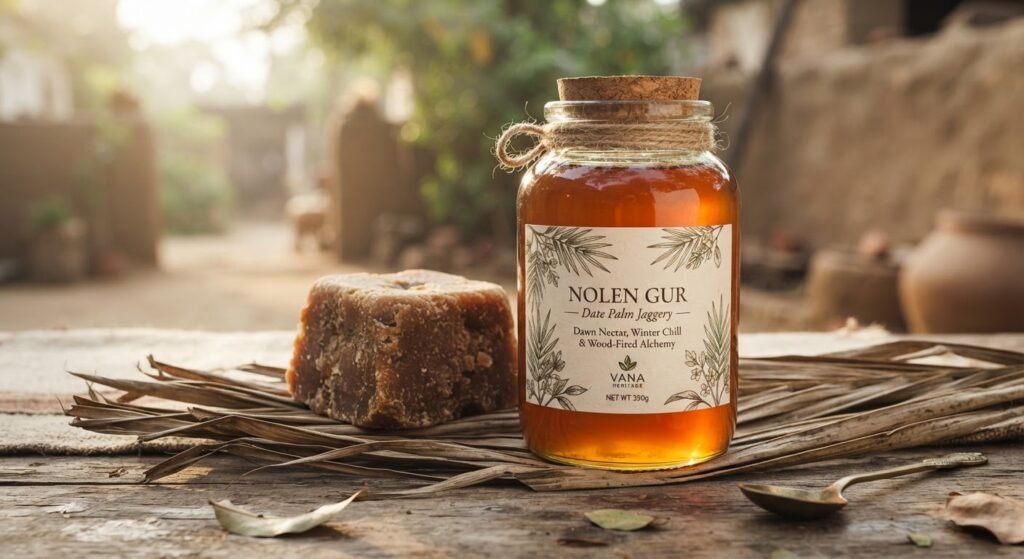
Between 11:00 PM and 5:00 AM, continental cold air fronts descending from the sub-Himalayan plains become trapped in the low river depression. Ambient temperatures plummet to 10°C–13°C, generating ground-level radiative fog that acts as a natural botanical refrigeration blanket over the collecting pots.
Gangetic Deep-Alluvium Silt
The floodplain soils of Nadia and Jessore consist of Holocene silt deposits layered with decomposed organic matter and micro-salts. The date palm’s taproot system drills deep into non-saline ground tables, drawing mineral potassium and subtle trace sodium that balance the jaggery’s innate sweetness with rounded mineral complexity.
Diurnal Evaporation Gradient
By mid-morning, the winter sun burns off ground fog, plunging relative humidity down to 42%. This crisp, dry daytime atmosphere is indispensable: it allows open-pan boiling to evaporate moisture rapidly without atmospheric re-absorption, precipitating tight, silky micro-crystals in finished Patali blocks.
Chapter 03
The Four-Stage Harvest Rite of the Sihori
A high-precision botanical procedure performed twice daily on mature palm crowns, dictated by lunar chill cycles.
01
Crown Shaving (‘Chholai’)
Ten days before tapping, older thorny fronds are excised using a curved iron blade (Dā). The rough brown fibrous layers are shaved with millimeter precision to expose the soft, pale cambium wood without severing inner vascular tissue.
02
Pot Suspension (‘Bhar Bandha’)
At dusk, a V-shaped incision is grooved into the cambium. A slender hollow bamboo reed (Nol) is tapped into the heart. Below it, an earthen vessel (Bhar), smoked over dry straw fire to sterilize bacteria, is secured to catch nocturnal drops.
03
Pre-Dawn Decanting (‘Jhol Namano’)
Before the sun rises above the tree canopy, the tapper climbs the trunk and lowers the full pots using hemp cordage. The sap collected on this first night is water-clear, sweet, and crystalline, termed Jhola Ras.
04
The Resting Cycle (‘Jiran’)
A single palm tree is tapped for a maximum of 3 consecutive nights (yielding First-Night Dō-Kāṭ, Second-Night Jhālā, and Third-Night Te-Kāṭ). The tree is then rested for 4 days so the incision seals naturally and reserves replenish.
Chapter 04
Open-Pan Wood-Fired Evaporation (Kadhai Boiling)
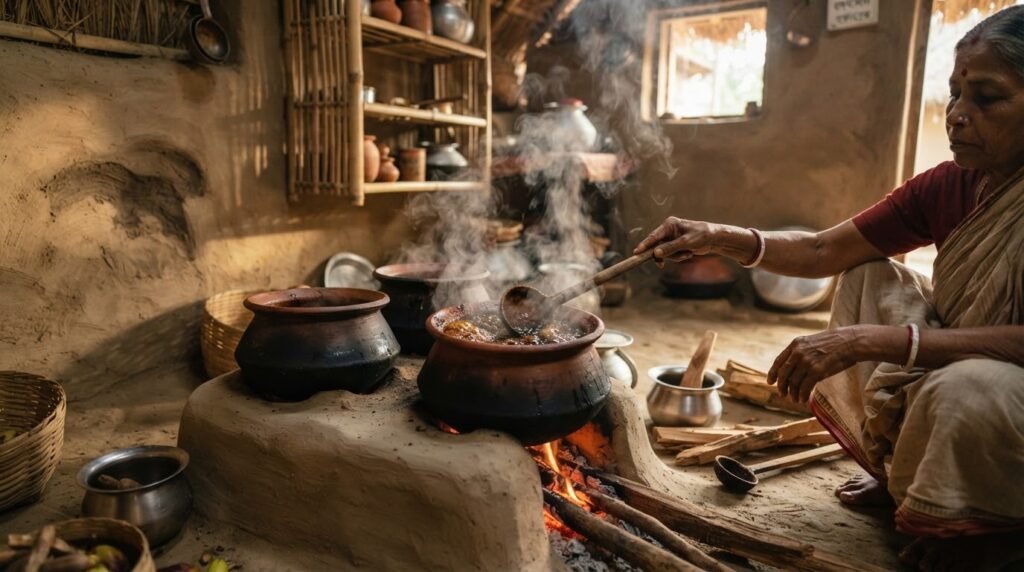
The conversion of raw date sap into Nolen Gur is a delicate study in thermodynamics. Boiled in open, shallow iron cauldrons (Kārhāi) set over underground mud hearths (Chulhī), the fuel consists exclusively of dry fallen palm fronds and husk wood, imparting a sublime, barely perceptible wood-smoke whisper without harsh soot.
01
Froth Cleansing (‘Moyla Kata’)
As the clear sap approaches initial simmer, albumen proteins and microscopic plant waxes coalesce into surface scum. The artisan skim-clarifies this froth with wild okra stems, avoiding artificial chemical bleaching agents like hydros.
02
Liquid Gold (‘Jhola Gur’)
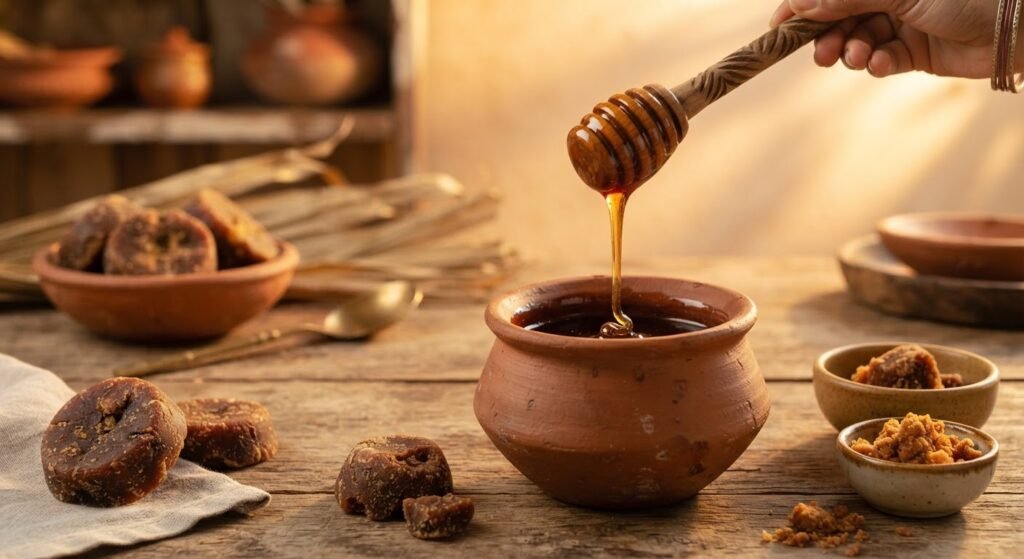
Moisture evaporates until the sap achieves viscosity. Poured hot into glazed earthen jars, this is the coveted liquid Nolen Gur: intensely aromatic, pouring with deep amber silkiness and tasting of date honey, cardamom, and warm cream.
03
Thermal Agitation (‘Bichha’)
Removed from direct flames, the viscous syrup is beaten rhythmically against the sides of a wooden basin with sal-wood paddles. This introduces uniform micro-nucleation seeds necessary for homogeneous crystal growth.
04
Solid Hardening (‘Patali Gur’)
The aerated crystalline fudge is poured into terracotta saucers or round sal-leaf molds. Within twenty minutes of contact with the crisp morning air, it sets into crystalline disc cakes with a melt-in-the-mouth crumb.
Chapter 05
Sensory Profile & The Volatile Aroma Paradox
Chromatographic notes and organoleptic tasting metrics of authentic Bengal Phoenix sylvestris nectar.
Chromatic Spectrum
In its liquid Jhola form, an unclouded translucent amber glowing with reddish mahogany undertones when held to morning light. Solid Patali displays a dusky, matte fawn-chestnut crust with fine microscopic sugar granulation when fractured.
Olfactory Complexity
Top notes of wild riverbank blossom honey, toasted walnut shell, and gentle woodsmoke. Opens in warmth to reveal green sugarcane sap, brown butterscotch, and volatile trace vanillin esters absent in cane jaggery.
Palate Progression
Strikes the front palate with instant, clean floral sweetness that dissolves without cloying molasses heaviness. Mid-palate presents smooth roasted hazelnut and warm cardamom, lingering into a subtle, mineral-saline finish.
Bioactive & Glycemic Matrix
Lower glycemic response than refined sucrose (GI ~54). Naturally endowed with 11mg bioavailable iron per 100g, polyphenolic antioxidants, and respiratory-clearing alkaloids revered in classical Ayur-Vedic winter formulations.
Chapter 06
Culinary Heritage & Kitchen Rituals
Time-honored preparation doctrines developed across centuries of Bengali confectionery art.
Full-cream dairy is reduced with short-grain fragrant Gobindobhog rice. Crucial culinary rule: Khejur Gur contains delicate trace fruit acids. It must be stirred into the pudding only after switching off the heat, resting the pot for 4 minutes to prevent milk curdling.
In cold winter breakfasts, crystalline Patali cakes are shaved wafer-thin and eaten alongside piping hot, puffed green pea breads flavored with roasted hing and ginger. The dynamic clash of spiced savory and melting floral sugar is peerless.
Nolen Gurer Payesh
Gobindobhog rice and date jaggery rice pudding.
Winter Patali & Koraishuti Kochuri
Savoury asafoetida green pea bread with shaved jaggery.
Hot Amber Drizzle on Clabbered Milk
Before sealing cultured buffalo milk in unglazed red clay pots for nocturnal fermentation, warm Jhola Gur is swirled through the cream. The porous clay allows subtle moisture release, concentrating the butterfat around the date caramel core.
Preserving Volatile Date Esters: The 90-Day Freshness Window
Genuine, additive-free Khejur Gur has not been stripped by synthetic preservatives or stabilized with artificial corn syrups. Liquid Nolen Gur contains live botanical active compounds and must be refrigerated in airtight glass upon opening. Consume within 90 days of harvest. If stored at warm ambient room temperature in high humidity, the delicate floral aroma will degrade into heavy generic molasses.
Chapter 07
Field Integrity vs. Market Adulteration
Establishing the benchmark standards for single-grove botanical Bengal jaggery.
Zero Cane Sugar Bulking
Commercial adulterators boil white cane sugar into inferior sap to double yield. Grinoz guarantees 100% pure date palm phloem sap with zero outside saccharides.
Hydros & Bleach Free
Zero sodium hydrosulphite used to cosmetically brighten color. Our deep amber and fawn tones are purely natural products of gentle thermal Maillard reactions.
Direct Guild Dignity
Sihori tappers risk physical peril climbing 30-foot trees twice nightly. We pay direct guild premiums 3.4× above the regional wholesale market to keep the ancestral craft alive.
Single-Grove Provenance
Every batch is numbered and geo-traceable to specific palm groves in Nadia and Jessore belts. No blending with cheap coastal sap from unfamiliar terroirs.
Questions
Common questions
Why does genuine Nolen Gur sometimes curdle milk if boiled directly together?
Unrefined date palm nectar retains wild botanical organic acids (malic and trace ascorbic acid) that give it its signature floral complexity. When boiled aggressively alongside milk proteins, these acids cause instantaneous coagulation. Always turn off the flame, allow the milk to cool for three minutes, and then fold in the jaggery.
What is the structural difference between Jhola Gur and Patali Gur?
Both originate from the identical nocturnal date palm sap. Jhola Gur is decanted at 105°C as an intensely aromatic, pourable liquid syrup. Patali Gur is cooked further to 122°C and mechanically agitated with wooden paddles to induce crystalline seeding before being molded into solid cakes.
How can one distinguish genuine Khejur Gur from dyed sugar jaggery at home?
Dissolve a piece in room-temperature water. Real Khejur Gur dissolves gradually, leaving clear golden water with natural aroma. Adulterated cane sugar cakes leave chalky white sediments (excess lime) and an overwhelming cloying sweetness without floral bouquet. Furthermore, authentic Patali softens at skin temperature.
Can genuine liquid Nolen Gur crystallize in the refrigerator?
Yes. Because pure Jhola Gur contains high concentrations of natural, unrefined sucrose, long refrigeration may cause fine, crunchy micro-sugar crystals to settle at the base of the jar. This is an indisputable mark of botanical purity, not spoilage. Simply place the sealed glass jar in a warm water bath for ten minutes to restore its flow.
Taste it yourself
Khejur Gur
Date palm sap tapped at dawn and simmered slowly over wood fires into a smoky, floral, butterscotch-sweet jaggery.
From ₹160Buy nowAdd to cart This product has multiple variants. The options may be chosen on the product page
Keep reading