Free shipping across India on orders over ₹1,499 · See this season’s offers

Home / Know Your Ingredients / Mithila Makhana
The Nocturnal Lotus Waters of Mithila
Freshwater wetland ecology, pond-bed foraging and the ancestral craft of clay-pot popping.
“Before sunrise, when the surface waters chill to 22°C, the prickly shells rupture and the seeds sink into four feet of fertile alluvial silt.”
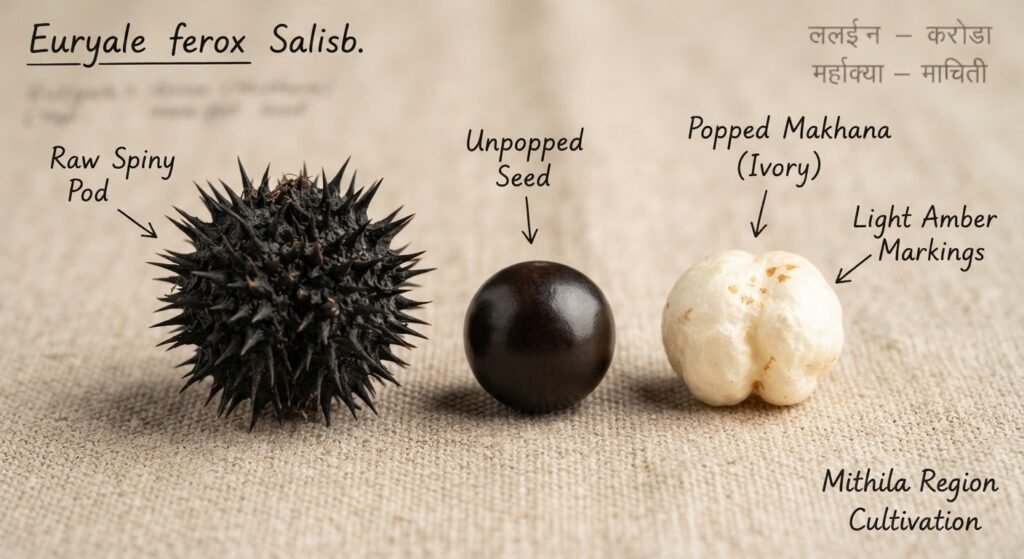
At a glance
- Botanical nameEuryale ferox Salisb.
- FamilyNymphaeaceae
- RegionDarbhanga & Madhubani, Bihar
- Coordinates26.15° N, 85.90° E · 52 m
- HarvestAugust – October
- Harvested byMallah fishing communities
Text and photos on this page are sample content from the mockups. Replace them with your own before launch.
Chapter 01
The Prickly Water Lily’s Sacred Seed
In Western nomenclature, it bears the formidable mythological title Gorgon Nut or Fox Nut; in botanical registers, Euryale ferox. Yet across the waterlogged floodplains of Mithila, it has simply been revered for millennia as Makhana, derived from the Vedic Sanskrit root Makh, designating food sanctified through fire ritual and primordial sacrifice.
Unlike conventional agricultural commodities grown in furrowed topsoil, Euryale ferox is an amphibious, violently defensive aquatic plant. Its leaves unfold into ribbed green shields exceeding four feet in diameter, armored on both dorsal and ventral planes with razor-sharp spines designed to ward off herbivorous fish and migratory wading fowl. Deep beneath this aquatic fortress, solitary purple flowers bloom silently under cover of night, self-pollinating beneath the water surface before surrendering their swollen berry chambers.
Today, commercial demand has introduced intensive agro-industrial farming where mechanized dredgers scour man-made shallow basins. In contrast, Grinoz works exclusively with heirloom perennial wetlands, where natural lake ecology remains untouched by petrochemical fertilizers, preserving an unbroken five-century harvesting lineage.

The Mithila Cultural Trinity
In classical Maithili civilizational folklore, three sacred elements define home and hospitality: “Paan, Makhana, aur Machh” (The betel leaf, the popped water lily seed, and the freshwater fish). No wedding rite, lunar festival, or ritual fasting period across Northern Bihar is deemed spiritually sanctified without the pristine, unbleached presence of hand-cracked Makhana.
Chapter 02
The Oxbow Wetlands of North Bihar
Euryale ferox requires an exquisitely specific aquatic niche: stagnant to slow-moving perennial waters replenished by the Himalayan river basins of the Koshi, Kamla, and Gandak.
Industrial vacuum dredgers disrupt the delicate stratification of the oxbow silt bed, crushing perennial root rhizomes and killing indigenous carp and mollusk populations that naturally aerate the water. Hand-foraging by the Mallah community preserves the biological web: divers select only mature fallen seed pods, leaving seedling reserves intact for the subsequent monsoon emergence.
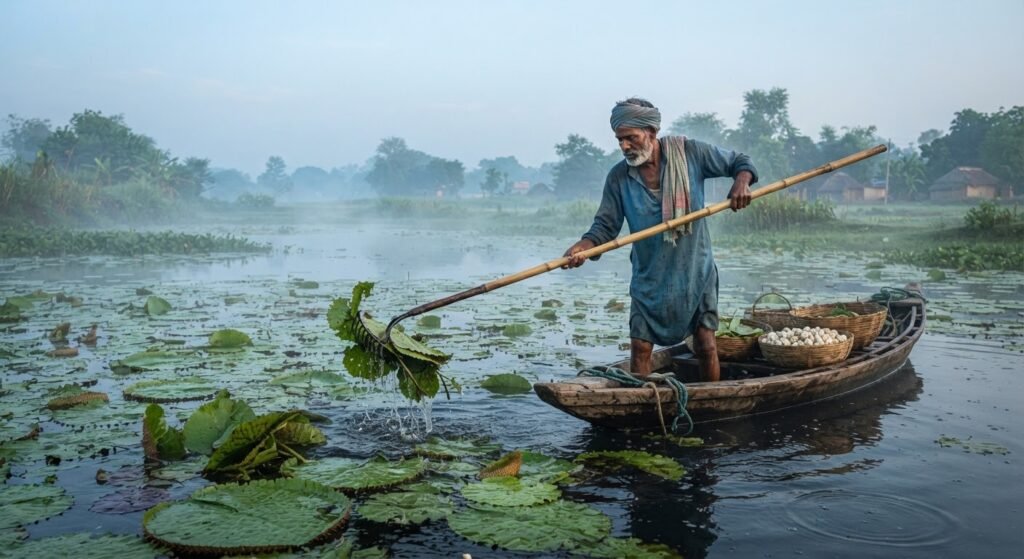
The Oxbow ‘Maun’
Naturally abandoned meander bends formed by shifting Himalayan river systems create shallow, tranquil oxbow lakes known regionally as Maun. These closed hydrological pockets hold calm rainwater, preventing mechanical turbulence.
Clay-Loam Silt Stratum
Pond floors accumulate decades of decomposing bio-organic mulch. The sediment is rich in humus with a balanced pH of 7.2 to 7.6, creating an oxygen-poor benthic nursery where the heavy fallen seeds mature during autumn dormancy.
Pond Micro-Climate
Intense subtropical summer heat (upwards of 35°C) initiates rapid vegetative leaf expansion, followed by mild, clear autumn conditions where surface waters drop to 20°C, triggering natural seed pod abscission and drop.
Chapter 03
Mud-Bed Foraging: The Fourfold Harvest Cycle
Between late August and October, the Mallah community begins a physically grueling ritual requiring exceptional lung capacity, tactile foot dexterity, and ancestral knowledge of pond geometry.

01
Clearing the pond
Before sunrise, foragers clear decaying thorny leaves floating on the surface to expose the benthic lanes. This prevents thorny punctures during deep submerged dives.
02
Diving for seeds
Divers hold their breath for up to 90 seconds, sweeping conical bamboo baskets (Ganj or Tiwar) through dense bottom silt to trap sunken seeds settled on the clay bed.
03
Foot-sifting
Harvested muddy mass is agitated using rhythmic foot-sifting on shoreline ramps, peeling off the reddish-black fibrous aril coat to leave hard, pebble-like black seeds (Gudi).
04
Sun-curing
Cleaned seeds are sun-spread onto handwoven split-bamboo mats (Chattai) for 36 hours. Moisture levels are calibrated to an exact 12% baseline before thermal popping.
Chapter 04
From Black Pebble to Ivory Cloud
The transformation of rock-hard black seed (Gudi) into an airy, cloud-soft popped puff (Lava) is a triumph of thermodynamic intuition. No mechanized factory has succeeded in replicating the instantaneous sensory rhythm of the Maithili hand-roasters.
The outer shell is as hard as walnut wood. To pop it requires creating immense steam pressure inside the starch endosperm while simultaneously keeping the lignified shell hot and brittle enough to crack instantaneously upon impact.
Once seeds finish sun-curing on bamboo mats, the thermal roasting window is strictly under 3 hours. If delayed, ambient moisture crystallizes the starch core, rendering the seed permanently unpoppable.

01
Stage A: Cast-Iron Pre-Tempering
Seeds tumble slowly in heavy cast-iron shallow pans over low wood heat. This softens internal amylose starches into a viscous gel without burning the thick black hull.
02
Stage B: Earthen Clay-Pot Flash Roasting
Tempered seeds are transferred directly into red terracotta pots built directly into the clay earthen stove. The radiant porous clay transfers dry, extreme flash heat in under 45 seconds.
03
Stage C: The Wooden Mallet Strike ('Thapi')
Hot seeds are tipped onto a smooth wooden block. In a fraction of a second, an artisan strikes each scalding seed with a curved wooden paddle mallet (Thapi). The brittle hull shatters instantly.
04
Stage D: Pneumatic Expansion (The Pop)
Superheated internal water flashes to steam, causing the gelatinized endosperm to explode outward at three times its raw volume, instantly setting into an irregular ivory cloud.
Chapter 05
Sensory Profile & The Unbleached Seal
Authentic artisanal Makhana is never stark, chalky white. It carries the signature textural and chromatic fingerprint of unadulterated botanical harvest.

Chromatic Identity
Warm, natural unbleached ivory. Presence of subtle amber specks where the inner seed pericarp clung during mallet-striking. This is definitive proof that no chemical bleaching was applied.
Acoustic & Palate Crunch
Crisp initial resistance yielding into an airy, cloud-like dissolve. Completely free of the rubbery, styrofoam-like chewiness characteristic of industrial re-hydrated stock.
Olfactory Notes
Delicate toasted earth, sweet dried reed marsh, and faint hazelnut aroma derived from clean wood fire in traditional clay ovens. Clean, restorative finish.
Nutritional Matrix
Naturally low-glycemic, gluten-free, rich in plant-based flavonoids (kaempferol), magnesium, and potassium. Exceptionally bio-available protein density.
Chapter 06
Culinary Heritage & Serving Protocols
Because of its neutral starch structure, Makhana serves as an extraordinary vessel for aromatic fats, spices, and slow reductions.
Always transfer to hermetic amber glass jars or air-tight sealed tin canisters immediately upon unsealing foil seal.
If puffs soften, do NOT microwave. Place in a dry, ungreased cast-iron skillet on low flame for 180 seconds. Allow to cool completely; ambient cooling resets the starch structure to pristine brittle crispness.

Mithila Makhana Kheer (Slow Clay-Pot Reduction)
Slowly crush whole unbleached Makhana coarsely by hand. Lightly toast in cultured A2 Bilona Cow Ghee until golden. Simmer in full-fat earthen clay pot milk reduced by half, flavored with cracked green cardamom pods, Persian saffron filaments, and sweetened exclusively with unrefined Bengali Date Palm Jaggery (Nolen Gur).
Mineral Pan-Tossed Puffs with Pink Himalayan Salt
Heat a heavy iron skillet over gentle flame. Add 1 tablespoon cold-pressed coconut oil or A2 cow ghee. Toss 100g jumbo Makhana continuously for 4–5 minutes until audibly crisp. Finish immediately with stone-ground rock salt (Sendha Namak) and cracked black Tellicherry pepper.
Stone-Milled ‘Falahari’ Bread & Flatbreads
During ritual fasting (Vrat), whole grain wheat and rice are excluded. Dry-toasting and stone-milling raw Makhana into fine flour produces an exceptionally light, gluten-free base for delicate flatbreads (Phulkas) and nutritious restorative broths.
Preserving Texture in Humid Climates
Because artisanal Makhana has zero preservative waxes or plasticized seed glazes, it naturally breathes and absorbs environmental water vapor.
Chapter 07
Archival Field Notes & Ecological Wisdom
Insights gathered from four generations of Mallah elder-foragers across the Madhubani and Darbhanga wetlands.
Geographical Indication (GI) Protected
Mithila Makhana was formally granted Geographical Indication status (GI Registry #696), legally authenticating its distinct biochemical composition shaped uniquely by Northern Bihar’s floodplains.
Self-Regulating Pond Regeneration
Following seed drop, the spiny leaves die back naturally under winter chill, decomposing into rich benthic humus that enriches the pond bed with over 40% organic compost for the subsequent year’s cycle.
Zero Ground-Water Irrigation
Unlike water-intensive field crops, wild Euryale ferox requires zero borewell depletion. It thrives exclusively on monsoon deluge waters held passively in historic community water bodies.
The Ancestral Mallah Foraging Guild
Harvesting is governed by collective community consensus: divers rotate pond access, ensuring no single oxbow lake is over-scoured, preserving the seed-bank for natural propagation.
Questions
Common questions
Why does Grinoz makhana have tiny brown or black specks?
They are fragments of the seed’s natural skin left after hand-cracking. Unbleached makhana is never stark white, the specks show it has not been treated with sulphur or peroxide.
What do the grades mean?
Makhana is sorted by size. Jumbo or Grade 1 kernels are over 22 mm across, pop more evenly and stay crisper.
How do I keep makhana crisp?
Store it airtight. If it softens, dry-toast it in a pan over low heat for 2–3 minutes; do not microwave.
Taste it yourself
Mithila Makhana
Hand-harvested from wetland ponds and popped using traditional methods for a light, airy crunch.
From ₹150Buy nowAdd to cart This product has multiple variants. The options may be chosen on the product page
Keep reading